New DFG project funding
The project centres on the development of an AI-supported, computer-assisted planning assistance system for cardiac surgery. The aim is to plan surgical interventions on the left ventricle more precisely and in a more patient-specific manner in future - particularly in the case of surgical ventricular restoration (SVR).
What is SVR?
After a major heart attack, an area of scarring can form and the left ventricle can expand abnormally as a result of adaptation (remodelling). This results in a so-called cardiac wall aneurysm: a weakly contractile, balloon-like bulge that significantly impairs the heart's pumping function.
In "SVR" surgery, this damaged area is removed and the ventricle is reconstructed in such a way that the volume and geometry of the ventricle are normalised. The challenge here is that each procedure is individual and the effects on blood flow and cardiac output are difficult to assess in advance.
Simulation with digital patient twins
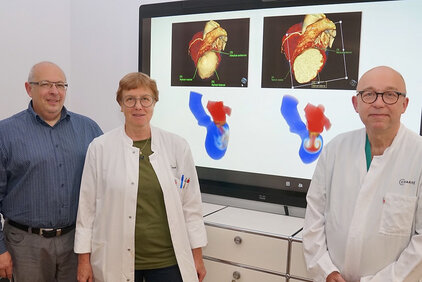
This is where heartCAAS comes in. With the help of three-dimensional digital patient twins, which are generated from CT image data, the effects of the planned operation can be simulated mathematically. This makes it possible to analyse in advance how the shape, wall movement and even the blood flow would change after the operation.
Based on this, an artificial intelligence is to be developed that learns from a large number of such simulations - with the aim of supporting surgeons in choosing the best surgical procedure. The DHZC research team plans to use the modelling technology for other patient groups with heart failure in the future.
Basis of the application
The funding application is based on the team's scientific work, in which the effects of SVR on haemodynamic parameters such as blood flow, energy loss and washout behaviour were investigated in nine patients. These analyses are already based on the method of digital patient twins and form the methodological basis for the project that has now been approved: www.sciencedirect.com/science/article/pii/S0010482525005785
We wish PD Dr Natalia Solowjowa, PD Dr Christoph Knosalla and Prof. Dr.-Ing. Leonid Goubergrits continued success in the realisation of this project.