Automated segmentation and classification of intracranial aneurysms
Über das Projekt
The project aims to improve the risk assessment and management of high-risk intracranial aneurysms through the development of automated, imaging-based methods. The focus is on analysing the morphology and haemodynamics of aneurysms using computer-aided simulations and AI-supported image processing. The aim is to minimise variability and uncertainties in the assessment of rupture risk and thus provide a clinically relevant basis for decision-making.
The project involves the automated segmentation of aneurysmal geometry and the analysis of haemodynamic parameters using state-of-the-art imaging data to improve individual prognoses. In doing so, correlations between morphology, flow behaviour and rupture risk are systematically investigated. Through collaboration between clinics and engineers, robust, clinically applicable standards are to be developed to optimise the early detection, diagnosis and risk assessment of intracranial aneurysms. The findings are to be integrated into precise, patient-specific decision-making and will improve the clinical management of future aneurysms in the long term.
The project aims to improve the risk assessment and management of high-risk intracranial aneurysms through the development of automated, imaging-based methods. The focus is on analysing the morphology and haemodynamics of aneurysms using computer-aided simulations and AI-supported image processing. The aim is to minimise variability and uncertainties in the assessment of rupture risk and thus provide a clinically relevant basis for decision-making.
The project involves the automated segmentation of aneurysmal geometry and the analysis of haemodynamic parameters using state-of-the-art imaging data to improve individual prognoses. In doing so, correlations between morphology, flow behaviour and rupture risk are systematically investigated. Through collaboration between clinics and engineers, robust, clinically applicable standards are to be developed to optimise the early detection, diagnosis and risk assessment of intracranial aneurysms. The findings are to be integrated into precise, patient-specific decision-making and will improve the clinical management of future aneurysms in the long term.
Schematic diagram
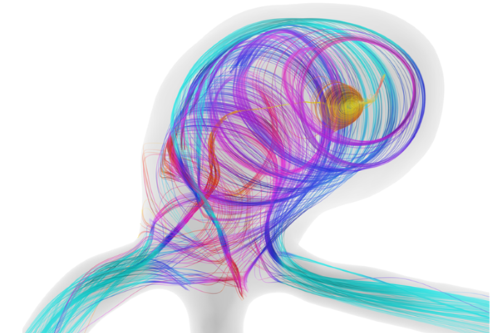
Schematic diagram

Projektinformationen
Keywords
Kennzahlen
DFG
Ihr Ansprechpartner
Leonid Goubergrits, Prof. Dr.-Ing.