Model-based treatment planning for patients with complex heart valve diseases
Über das Projekt
This project aims to significantly improve the treatment of complex heart valve diseases through the use of innovative in silico models. The current clinical approach is heavily focused on average patients and does not take into account individual variability in complex and rare heart diseases. In particular, in cases of combined heart valve defects, such as aortic valve stenosis combined with mitral valve regurgitation, there is a significant need for optimisation in order to develop and predict optimal treatment strategies.
The project combines physical and data-driven modelling approaches into a hybrid decision support system that realistically simulates the haemodynamic interaction of different heart valves. The aim is to develop a user-friendly platform that utilises individual patient data to predict the effects of various interventions in real time, thereby enabling the precise and low-risk planning and execution of surgical and interventional procedures.
Through validation using clinical imaging data and the use of artificial intelligence, the system aims to improve clinical decision-making, enhance treatment safety and significantly improve treatment outcomes. The work builds on previous successful research projects that demonstrate the validity of image-based flow simulations and the use of synthetic data in a clinical context.
Decision support system (DSS) in this use case: Patient-specific data (imaging data, unstructured data from diagnostic reports, discharge summaries, etc.) is entered into the DSS.
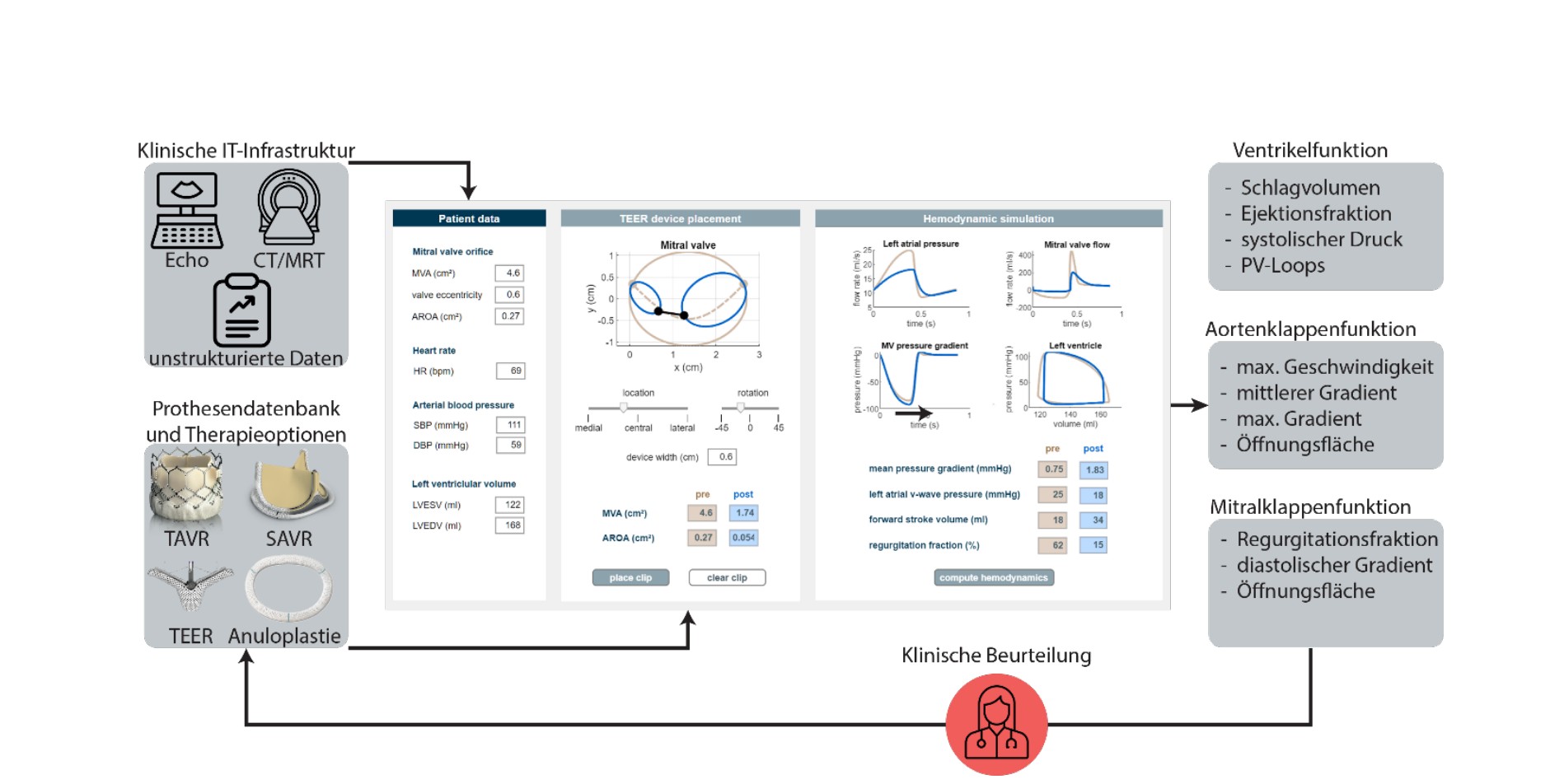
Decision support system (DSS) in this use case: Patient-specific data (imaging data, unstructured data from diagnostic reports, discharge summaries, etc.) is entered into the DSS.
In addition, a suitable treatment option is selected from a list of defined models and procedures. The DSS then calculates the expected post-procedural haemodynamic parameters of the aortic valve, mitral valve and ventricle. If these are not satisfactory, the treatment strategy can be modified until the optimal treatment is identified. TAVR – transcatheter aortic valve replacement; SAVR – surgical aortic valve replacement; TEER – transcatheter edge-to-edge repair; PV loops – pressure-volume loop.
Projektinformationen
Keywords
Kennzahlen
EKFS
Ihr Ansprechpartner
Marie Schafstedde, PD Dr. med.