Turbulence and Blood Damage: An In Vitro Study of Turbulence-Induced Hemolysis in a Taylor-Couette System
Über das Projekt
The aim of the project is to investigate and quantify blood damage caused by turbulent mechanisms.
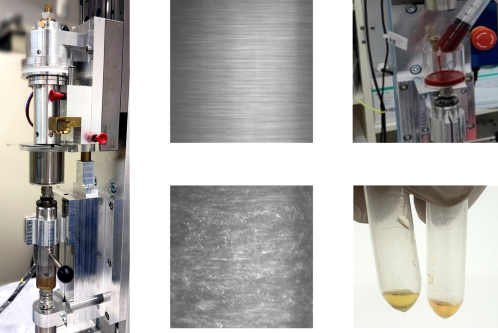
A new experimental model—a turbulence-generating Taylor-Couette system (TCS) with two counter-rotating cylinders—will be used to experimentally investigate blood damage. In this TCS, the inner and outer cylinders can rotate independently of one another. When both cylinders rotate in opposite directions at a specific combination of rotational speeds, a uniform turbulent flow is generated in the gap. In particular, by appropriately selecting the rotational speeds of both cylinders, a laminar flow with the same average shear rate as that prevailing in the turbulent regions can be generated in the same apparatus. This allows blood damage caused by turbulent effects to be compared with blood damage caused by the extensively studied laminar flow. The flow is experimentally investigated using a two-velocity-component LDA measurement in a blood surrogate fluid.
The characteristic turbulence parameters are determined as a function of rotational speeds, and the influence of flow state, turbulence intensity, and exposure time on these parameters is investigated. Furthermore, the variation in the measured parameters is examined. For this purpose, blood samples from animals and subsequently from healthy subjects are introduced into the TCS gap and analyzed using standard methods.
Subsequently, a correlation between blood damage and the turbulent flow parameters will be analyzed.
Projektinformationen
Keywords
Kennzahlen
DFG
Ihr Ansprechpartner
Leonid Goubergrits, Prof. Dr.-Ing.