
Applied Systems Medicine
The research group develops and investigates systems medicine approaches for integrating data from multiple biological sources (multi-omics), multi-sensor data, and other health-related data. The goal is the early detection of diseases, personalized risk assessment, and the development of specific prevention and treatment strategies.
Methodological focuses include:
- Data integration from high-dimensional and complex datasets, including sensor data, multi-omics data, image data, and public health databases
- Applied AI-supported analytics and explainable machine learning for phenotyping based on molecular and clinical information
- Development of self-learning systems with dynamic model training and validation approaches that are applicable to routine clinical data
AI-Based Risk Prediction Using Multi-Omics Models
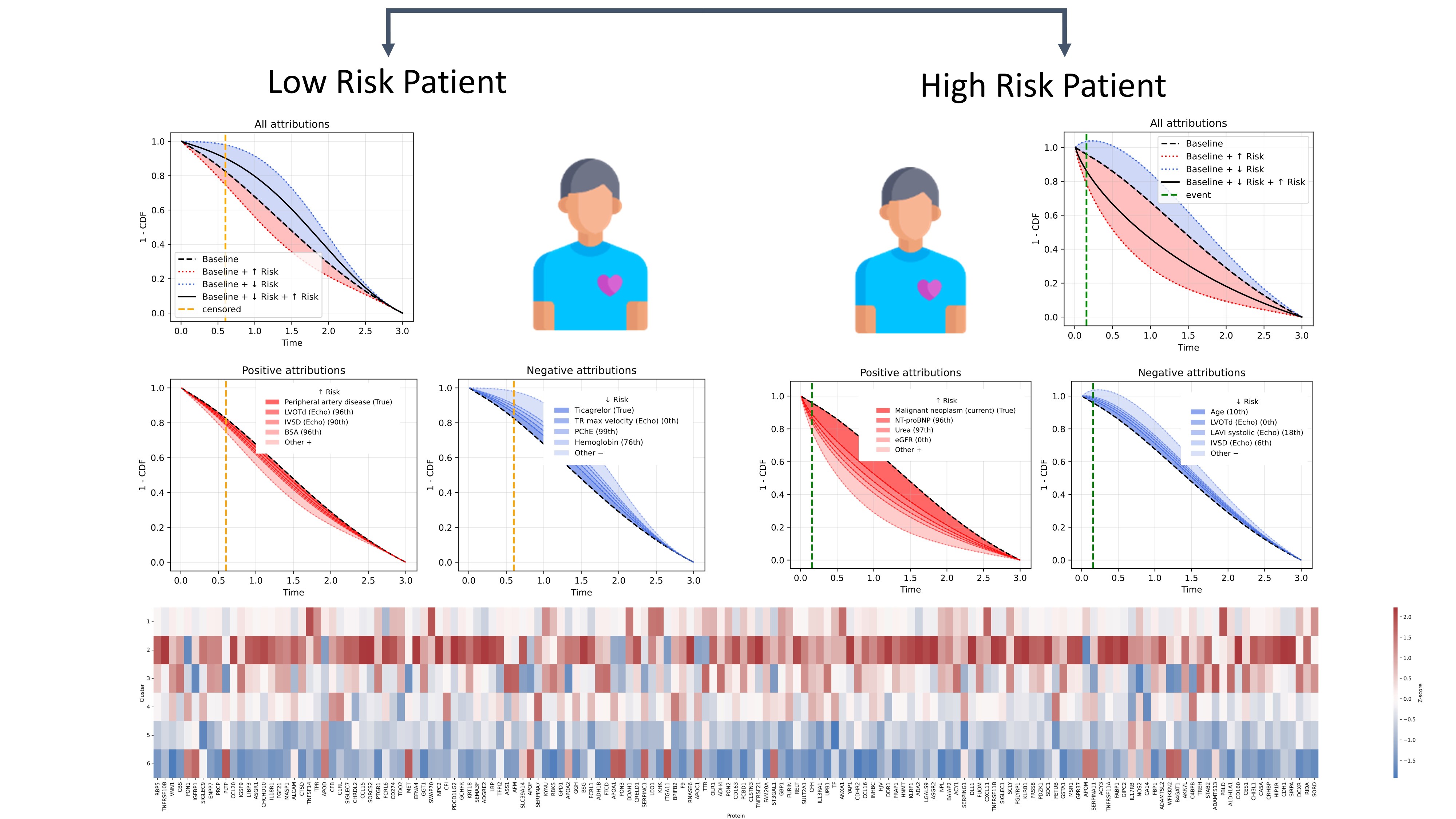
Prediction of risk trajectories in patients with different characteristic profiles. The curves illustrate how risk evolves over time based on relevant molecular and clinical factors derived from integrated multi-omics data, enabling the early identification of high-risk patient profiles.
AI-Based Risk Prediction Using Multi-Omics Models
Prediction of risk trajectories in patients with different characteristic profiles. The curves illustrate how risk evolves over time based on relevant molecular and clinical factors derived from integrated multi-omics data, enabling the early identification of high-risk patient profiles.
Web-based calculators
Im Rahmen von Forschungsvorhaben wurden verschiedene KI- und modellbasierte Verfahren und Tools entwickelt:
- https://icm.dhzc.charite.de/p/lv-myocardial-power-calculator-508/: The LV Myocardial Power Calculator is a tool that calculates, on an individual patient basis, the power required by the left ventricle to pump blood and how efficiently this power is transferred to the systemic circulation.*
- AI-based calculator for Treatment Outcomes in Aortic Coarctation: An AI-powered tool for predicting treatment outcomes in aortic coarctation (coarctatio aortae) that calculates and visually displays the individual risk of reintervention or persistent high blood pressure after clinical data is entered.*
https://icm.dhzc.charite.de/p/computational-stress-testing-for-coa-patients-507/: A model-based, non-invasive calculator that uses routinely collected imaging data and virtual stress testing to estimate the pressure gradient across a stenosis (validated using vascular stenoses). This allows pressure gradients to be predicted without invasive measurements and without additional procedural risks.*
*This tool is currently a research tool and not a medical device.
Current Projects
- Computational Stress Testing for CoA patients
- Explainable AI in continuously learning systems for heart failure
- Infrastructure project: “Central Image Management System” (BDMS)
- LV Myocardial Power Calculator
- Personalized decision support for heart valve diseases
- Phenomapping and system modelling
- Studies on vascular dysfunction and reduced perfusion in patients with ME/CFS
Leitung
Dr. med. Marcus Kelm
Head of Applied Systems Medicine

Dr. med. Marcus Kelm
Head of Applied Systems Medicine
