Development of a Photonic Microring Sensor for Point-of-Care Ion and Biomarker Detection
The physiological composition of electrolytes in the blood forms the basis for the body’s vital functions. Pathological changes in electrolyte concentration can, for example, impair heart and kidney function. In young children, measuring electrolyte concentration poses a challenge because the blood volumes collected are often too small for commercially available automated blood analyzers. As a result, life-threatening electrolyte imbalances may go undetected. The “PHIONa” project aims to develop a device concept incorporating novel photonic sensors that will enable electrolyte analysis using minute blood samples.
The measurement principle is based on optical micro-ring resonators (MRR). Laser light is guided through these ring-shaped optical fibers. As soon as molecules bind to the MRRs, the optical properties of the optical fiber change. These binding events can be measured with high sensitivity and tailored to specific applications through surface functionalization. Based on this measurement method, an interdisciplinary collaboration aims to develop a functional prototype capable of determining electrolytes simultaneously and in real time.
Schematic representation of the sensor unit with photonic chips into which the laser light is coupled and decoupled.
Each chip contains four functionalized micro-ring resonators (MRR). The transparent block represents
the microfluidic system with an inlet and outlet for sample delivery.
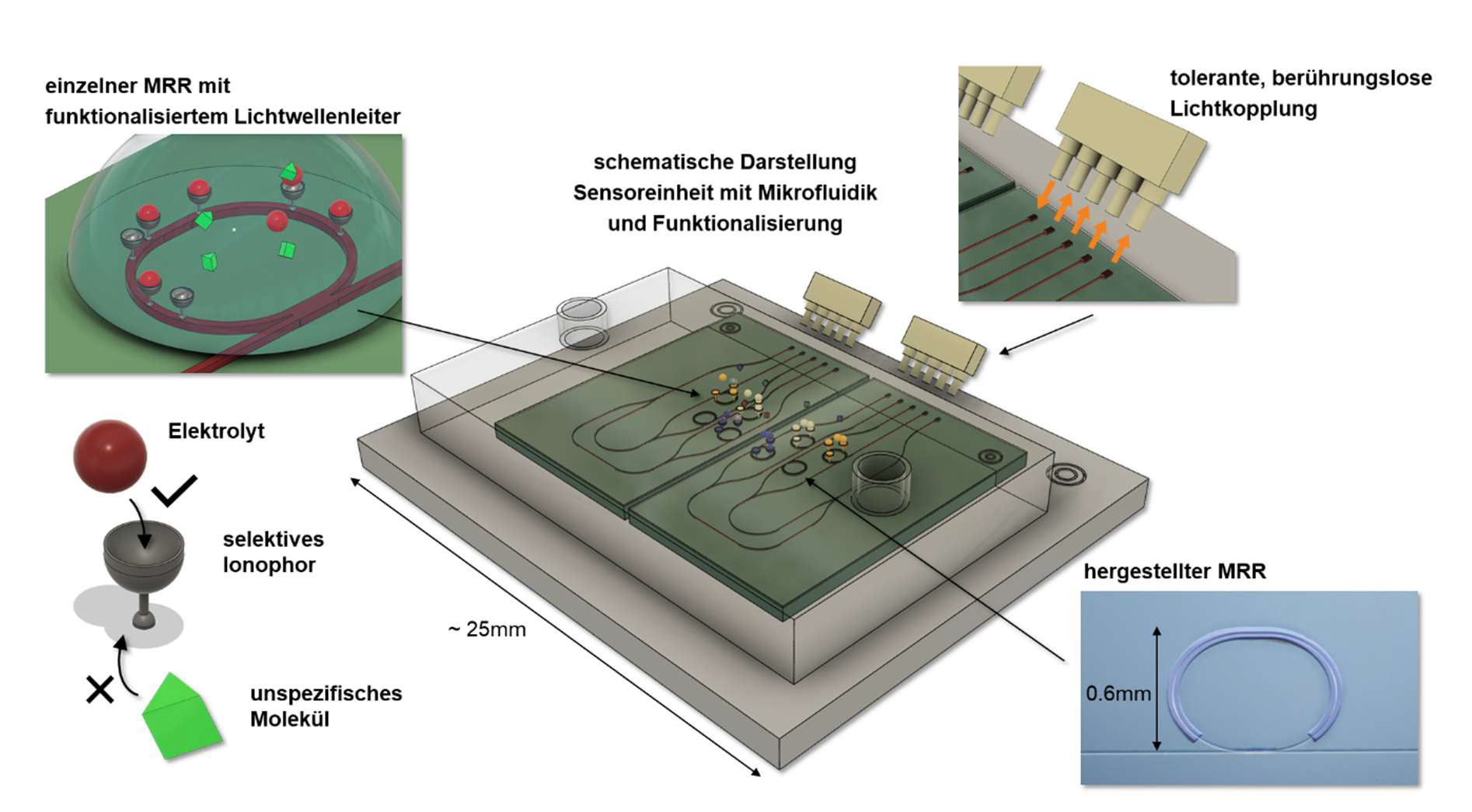
Schematic representation of the sensor unit with photonic chips into which the laser light is coupled and decoupled.
Each chip contains four functionalized micro-ring resonators (MRR). The transparent block represents
the microfluidic system with an inlet and outlet for sample delivery.
Project information
Keywords
Key Facts
BMWK und ZIM
Your Contact