Computational Stress Testing for CoA patients
Über das Projekt
This platform offers a simulation-based tool to assess blood flow behaviour in patients with aortic coarctation (CoA).
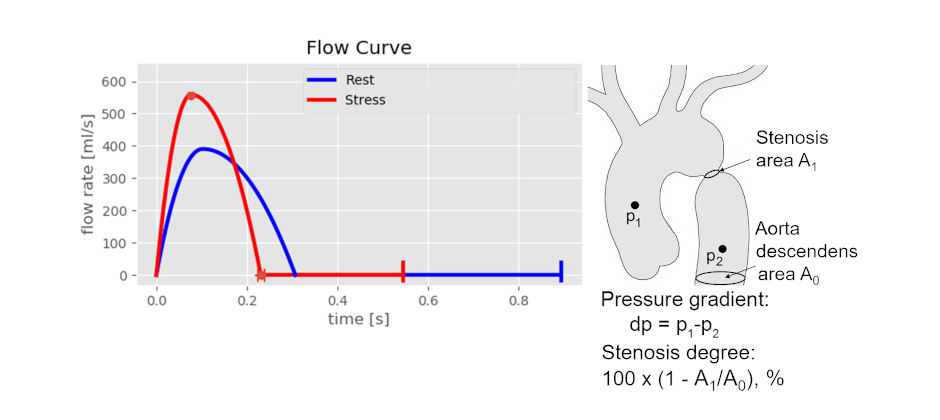
This platform offers a simulation-based tool to assess blood flow behaviour in patients with aortic coarctation (CoA).
This calculator predicts the cardiac response to dobutamine stress for patients with aortic coarctation (CoA).
This calculator is a research tool only, not intended for use in diagnostic procedures.
Changes in heart rate and stroke volume due to dobutamine stress testing were calculated based on a meta-analysis published by Runte et al. [1], whereas heart rate dependence of the systolic time was based on studies of Spodick et al. [2] and Weissler et al. [3].
Input parameters
Degree of stenosis range: 0 – 99 %
Dobutamine dose stress level:
Low: 0 – 10 µg/kg/min
Middle: 10 – 20 µg/kg/min
High: 20 – 40 µg/kg/min
Initialize parameters under resting conditions:
Press button CALCULATE to assess hemodynamic parameters:
Cardiac output at rest no yet calculated.
Cardiac output during dobutamine stress no yet calculated.
Pressure gradient during dobutamine stress no yet calculated.
Changes in heart rate and stroke volume due to dobutamine stress testing were calculated based on a meta-analysis published by Runte et al., whereas heart rate dependence of the systolic time was based on studies of Spodick et al. and Weissler et al.
References
- Runte K et al. Hemodynamic Changes During Physiological and Pharmacological Stress Testing in Healthy Subjects, Aortic Stenosis and Aortic Coarctation Patients: A Systematic Review and Meta-Analysis. Frontiers in Cardiovascular Medicine. 2019;6:43.
- Spodick DH et al. Systolic time intervals reconsidered. Reevaluation of the preejection period: absence of relation to heart rate. The American journal of cardiology 1984;53:1667-70.
- Weissler AM et al. Systolic time intervals in heart failure in man. Circulation 1968;37:149-59.
Sie haben Verbesserungsvorschläge? Kontaktieren Sie uns!
Projektinformationen
Keywords
Kennzahlen
Ihr Ansprechpartner