
Lecture on "Fluid Mechanics in Medicine"
We offer the course “Fluid Mechanics in Medicine” at TU Berlin. In connection with this course, we offer opportunities for theses (bachelor's theses, master's theses) as well as term papers and project work.
The figure shows a mechanical blood pump used as a cardiac assist device. Its design requires an understanding of fluid mechanics in the medical field.
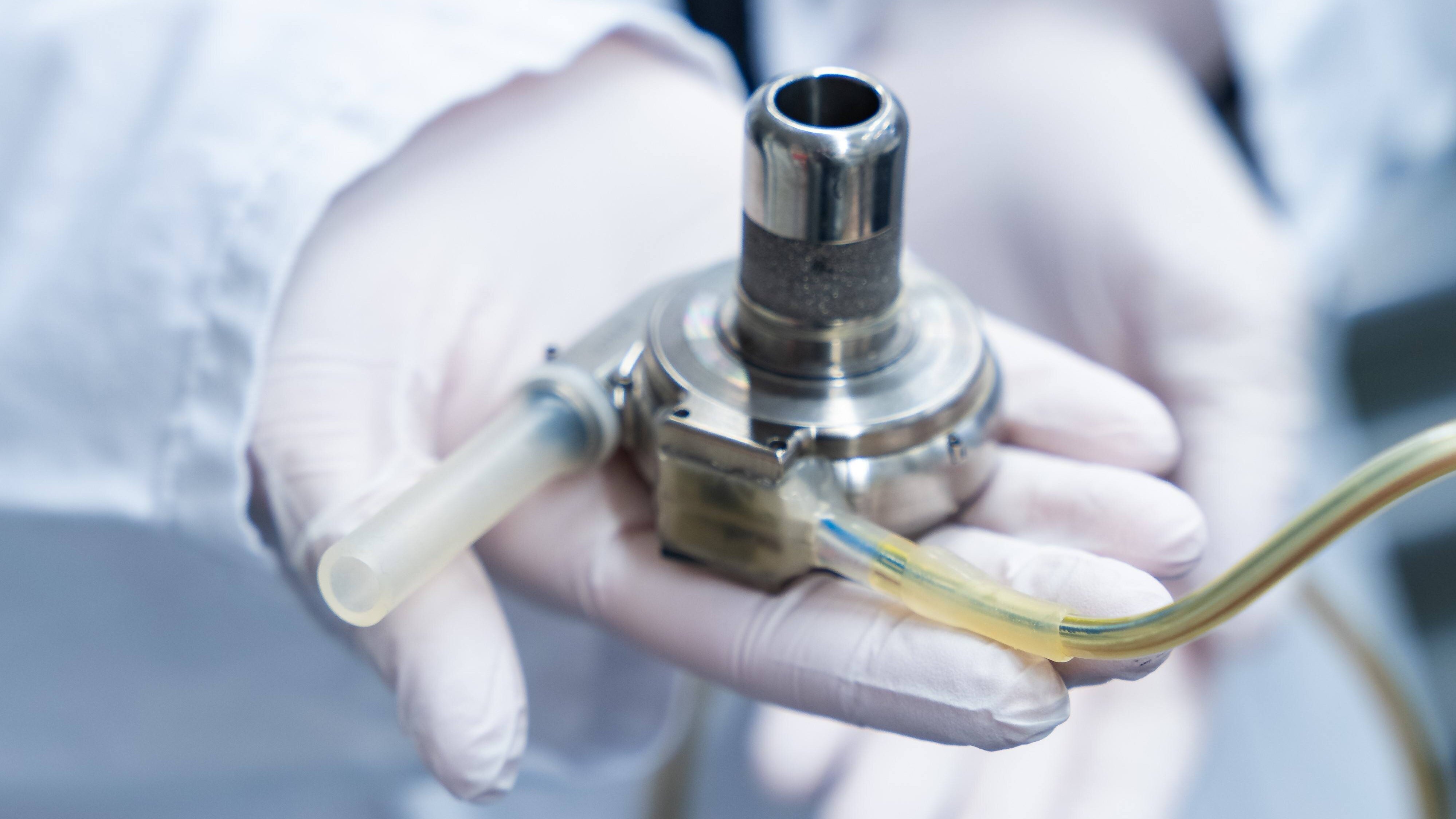
The figure shows a mechanical blood pump used as a cardiac assist device. Its design requires an understanding of fluid mechanics in the medical field.
Course
The course “Fluid Mechanics in Medicine” is an exam subject in the following degree programs, among others: Physical Engineering (specialization: Fluid Mechanics) and Mechanical Engineering (specialization: Biomedical Engineering). Students from other fields of study, such as Chemical Engineering or Biotechnology, also attend the course.
Please refer to the TU Berlin’s Moses system under the entry for the lecture for the current lecture dates.
Course Content
The lecture Fluid Mechanics in Medicine can be divided into two parts.In the first part, basic knowledge about the structure and functions of the circulatory system is taught from an engineering perspective. The focus is on understanding circulatory function, which is essential for planning technical interventions. Topics include:
- Function and development of the circulatory system
- Elements of the circulatory system (heart, valves, vessels)
- Flow phenomena in the circulatory system (pulse wave, turbulence, microcirculation)
- Rheological properties of blood
- Technical interventions for diagnosis and therapy
- Artificial organs (artificial heart valves, lungs, kidneys, and heart)
The second part provides basic knowledge of methods for diagnosing the circulatory system from an engineering perspective:
- Discovery of the circulatory system and blood pressure
- Invasive and non-invasive methods of blood pressure measurement
- Blood flow measurement and velocity measurement
- Flow noises in blood vessels and heart sounds
- Measurement of vascular and cardiac geometry (ultrasound, CT, MRI, angiography)
- Hydraulic and mathematical models of the circulatory system
- Viscosity of blood and blood-material interaction
- Thrombus formation
- Artificial heart valves and blood pumps
The lecture notes for both parts are available for download at the bottom of the page.
Theses and Internships
The institute offers required internships, project work, research projects, bachelor’s theses, master’s theses, and diploma theses in the fields of fluid mechanics, medical technology, and biotechnology. Here you will find an overview of the projects completed to date.
Interested parties are cordially invited to contact us. You can reach out via email to icm-office@dhzc-charite.de, attaching a current resume, a transcript of grades, and your preference for a numerical or experimental project. Alternatively, you can also reach us by phone at 030 - 450 553882.
Opportunities in Three Research Areas
There is currently an urgent need for theses in three research areas, as detailed in our document “Call for Thesis Proposals” (pdf).
Lecture notes for download
- Skript zur Vorlesung "Strömungsmechanik in der Medizin" (Teil I)
- Skript zur Vorlesung "Strömungsmechanik in der Medizin" (Teil II)
Presentations for download
- SMM-Vorlesung26_2025.pptx
- SMM-Vorlesung27und28_2025.pptx
- SMM_Vorlesung01und02_2025.pptx
- SMM_Vorlesung03und04_2025.pptx
- SMM_Vorlesung05und06_2025.pptx
- SMM_Vorlesung07und08_2025.pptx
- SMM_Vorlesung11_2025.pptx
- SMM_Vorlesung12_2025.pptx
- SMM_Vorlesung13und14_2025.pptx
- SMM_Vorlesung15_2025.pptx
- SMM_Vorlesung16_2025.pptx
- SMM_Vorlesung17_2025.pptx
- SMM_Vorlesung18_2025.pptx
- SMM_Vorlesung19und20_2025.pptx
- SMM_Vorlesung21_2025.pptx
- SMM_Vorlesung22_2025.pptx
- SMM_Vorlesung23und24_2025.pptx
- SMM_Vorlesung25_2025.pptx
